Showing posts sorted by relevance for query Capone. Sort by date Show all posts

Thursday, January 15, 2009

Al Capone Murders Joe Howard

Al Capone arrived in Chicago in 1921, working as a street-level thug for Johnny Torrio. Capone's business acumen led to quick promotion through the ranks of the gang. His capacity for violence didn't hurt either. An incident that occurred here, at 2300 S. Wabash, on May 7, 1923, proved early on Capone's willingness to employ the gun. The following day's Tribune reported:
Another murder in the liquor and crime serial was accomplished last night. Alphonse Capone, vice lord of the south side bad lands where he is better known as Al Brown of "Four Deuces" fame, is sought as the slayer.

The order to capture Capone went out thirty minutes after the body of Joseph L. Howard, beer runner and burglar, credited with three notches on his gun, was found lying in front of the cigar counter of "Hymie" Jacobs' saloon at 2300 Wabash avenue. Howard had been shot six times, four times in the face and twice in the right shoulder.
Howard was a low-level neighborhood hoodlum, and after one too many drinks, became involved in a physical altercation with a leading Torrio-Capone associate, Jake "Greasy Thumb" Guzik. When Guzik told Capone about the confrontation, Big Al hunted Howard down at Hymie Jacobs' bar, just a half-block from Capone's Chicago headquarters at the Four Deuces. When Capone arrived, he demanded an apology from Howard, and Howard replied by calling Al Capone a pimp -- a moniker he despised (though it was true). Thus, Capone's rage and violence.

After the command to find Capone went out, the police immediately checked the Four Deuces and Capone's home on Prairie Ave., with no success. Capone went into hiding for a month (probably in Cicero), while sending word through his lieutenants that any witnesses with loose lips had better think twice before talking to the police. In fact, though there were several eye witnesses in the saloon who say the murder, strangely it seemed that everyone just happened to be looking away at the exact moment of the killing.

"I'll bet 50 cents Al Brown didn't kill him, and I'll bet $50 they never convict him of the murder," was the word on the street.

Eventually, realizing the coast was clear, Capone walked into the police station one day, saying, "I hear you're looking for me. What's this all about?" A young assistant state's attorney, William McSwiggin, continued the investigation earnestly for a few more months, but was never able to put together enough evidence to prove Capone's involvement. A couple of years later, in 1926, McSwiggin himself met his end at the hands of Capone's henchmen, though accidentally, it seems.

Nevertheless, even years later, in 1931, Capone feared he might be prosecuted for the Howard murder, and sent Louis "Little New York" Campagna to "take care of" any remaining witnesses. But by that time, tax evasion was the more pressing problem for Big Al, and it doesn't seem that anything came of the order.

Interestingly, this wasn't even the first gangland murder to take place at this address. In 1913, Jimmie Kelly (nee James Fletcher -- for a time in the early 20th century, it was common for gangsters to change their names to sound more Irish) was found murdered in a hallway in the residence above the bar. Kelly was the leader of the Archer Avenue Gang, and was killed by rival gangsters.

The building that housed Hymie Jacobs' bar remained until the 1960s, when it was demolished. The lot currently serves as an industrial storage yard.

Sunday, August 9, 2009

Aiello & Co. Bakery


Joe Aiello had broken troth with his former business partner, Antonio Lombardo, and was actively scheming to kill Lombardo and his colleague in crime, Al Capone. On May, 28, 1927, Aiello’s bakery, located here at 473 W. Division St., took the brunt of Lombardo and Capone’s ire when it was riddled with over 200 machine gun bullets from in a gangland drive-by shooting.

Giuseppe Aiello, known as “Joe”, was born in 1890 in Sicily, into a very large family. Most accounts claim he was the oldest of seven brothers, but others indicate up to ten Aiello brothers, plus an unknown number of cousins, uncles, and nephews. Most of the family emigrated to the United States in the first decade of the 1900s, including Joe, who arrived at New York in 1907, then moved west to Chicago shortly after.

Food was the family business, and Joe operated first as a cheese-maker and grocer in the Little Sicily enclave on the near North side (also known as “Little Hell” for the poverty and violence that infested its streets). With his brothers, he also opened a wholesale bakery specializing in supersized wedding cakes and Italian breads, Aiello & Co., at 473 W. Division, near the corner of Clybourn Ave. He also held part ownership in a candy shop near Oak St. and Cleveland Ave. (then known as Milton St.), the original “Death Corner,” a popular Black Hand meeting (and “disposal”) ground.

At the onset of the 1920s, the Aiello clan was already prominent in the Sicilian-American community. National alcohol prohibition raised their profile further. During Prohibition, grocers played a particularly important role in the production of bootleg alcohol, since they could purchase and store large quantities of important distilling ingredients, such as sugar and grapes, without arousing the suspicions of police. Joe Aiello used his position as one of the neighborhood’s top grocers to become deeply involved in the business of illicit booze.

He joined forces with another prominent Sicilian grocer, Antonio Lombardo, and the two opened an import business on Randolph Street and purchased property on the west side at Kinzie and Halsted for an even larger operation. At the time, Lombardo was also president of the Unione Siciliana, the primary Italian organization in Chicago, a position that made him the most respected man in the immigrant community, and a political “fixer” with connections in city government and law enforcement. The Unione was a key element in organizing the massive, dispersed network of tiny home distilleries that supplied the low-quality liquor that was eventually retailed through Al Capone’s syndicate.

(Pictured: Giuseppe "Joe" Aiello)

Together with Lombardo and Capone, Joe Aiello ruled Chicago’s illegal alcohol trade into early 1926. The decline and fall of their fellow Sicilian booze entrepreneurs, the “Terrible Genna” brothers, in 1925 gave Aiello and Lombardo an even more important role to play in this business. But Aiello was too ambitious to be just one important part of the machine. He needed to control it all. He was especially jealous of Lombardo’s position at the Unione and the respect it earned him among their countrymen. And he despised Capone, a non-Sicilian he considered untrustworthy and undeserving of his wealth. Aiello’s constant attempts to control more of the alcohol syndicate eventually led to a break with Lombardo in 1926, and an all-out war for the control of the Unione and the Little Sicily neighborhood.

Aiello began working closely with the Northside Gang run by George “Bugs” Moran and Jack Zuta, while Lombardo remained close with Capone. Both Lombardo and Aiello keenly courted Sicilian grocers, demanding their loyalty and supply capacity. For his part, Aiello openly put price tags on the heads of Lombardo and Capone, offering up to $50,000 each to a series of hitmen in return for their lives.

In one important case, Aiello made a $35,000 deal with a cook at the “Little Italy” restaurant, located at 22nd and Cicero Ave., in the suburb of Cicero, to spice Capone and Lombardo’s soup bowls with prussic acid. The cook wisely decided against fulfilling the task and confessed the deal to Capone.

Other Aiello family members were also involved in warfare with Capone and Lombardo. Tony Aiello, Joe’s brother, was positively identified by a boy eyewitness as the murderer of Antonio “The Cavalier” Spano, a Capone associate operating out of Chicago Heights, who met his end just a block away from the Aiello brothers’ bakery on Division St. Tony managed to beat the rap despite the witness’ identification.

(Pictured: Tony Aiello)

Joe Aiello also attempted to hijack the Unione from outside, sending a gaggle of his brothers and nephews to St. Louis in an attempt to build a rival organization that he could eventually bring to Chicago. Their attempts to consolidate power in that city led to a dozen murders in 1927, including the deaths of two Aiello brothers while sitting in a restaurant in Springfield, Illinois.

Lombardo and Capone realized that Aiello would stop at nothing to gain control of the Unione and the alcohol business in Chicago. On the evening of May 28, 1927, just after nightfall, a curtained touring car filled with four Capone gangsters cruised past the Aiello bakery on Division St., produced machine guns, and carpeted the building from side to side with a tremendous fusillade. By the end of it, over 200 bullets had lodged in the roof, floor, and walls.

At the time, Joe was in the bakery with his brothers, Dominic and Tony, along with two employees. Tony was hit in the neck, and dropped to the floor screaming “I’m dead,” while one of the employees was also shot in the side. Dominic and Joe were upstairs and managed to dodge
the bullets. As soon as their assailants departed, Joe and Dominic helped Tony out of the building and into surgery under the care of a friendly family physician (Tony survived). By the time the police arrived, only one employee remained in the bakery to tell the tale. Officers were unsurprised to find that Aiello & Co. was one of the city’s most well-armed cupcake retailers – a case filled with shotguns was discovered in a back room.

(Pictured: interior of the Aiello bakery, facing the mirrored back wall, which was shattered by bullets)

One Joseph Paglisia was arrested for the crime a few days later, as he was spotted driving through Little Sicily with a Florida license in a car similar to that from which the bombardment of the Aiello bakery had originated. It was a custom with the Capone organization for particularly spectacular hits to be performed by gunmen imported from outside Chicago. Nevertheless, the police were unable to find any further evidence against Paglisia, and he was released. No one else was ever fingered for the crime.

The attack at Aiello & Co. raised the stakes in the feud over the Unione, and that summer, nine Italian grocers were found dead, likely caught in the war between Aiello and Lombardo. Aiello also stepped up his attempts to kill Lombardo. Instead of attempting to procure a hit, he decided to organize one himself. Police discovered machine gun nests across the street from Lombardo’s home on W. Washington Blvd. (an event that caused Lombardo to move his family out to Cicero), and across the street from Michael “Hinky Dink” Kenna’s cigar shop on S. Clark St., a common meeting place for Capone and Lombardo.

In retaliation, Aiello and his Northside Gang allies saw bombs explode at several of the businesses, including a brothel located at Adams and Halsted – Capone territory – and a disorderly hotel at Madison and Western. The violence in the city produced by the feud in late 1927 was tremendous. The police organized roving groups of officers, armed with automatic weapons and with orders to kill on sight any known gangsters. Chief of Detectives William O’Connor (who took over that position after Michael Hughes was demoted for being too chummy with gangland figures), took an especially hard line on crime:
The machine gun is a much better weapon than the law to fight gangsters with. If we would hold more murder trials in the street rather than trust timorous juries to convict killers, Chicago would not now be facing a gang crisis.
1927 also saw Joe and Dominic Aiello build a beautiful new home for themselves and their wives, far from the Little Sicily slums where they grew up, in Rogers’ Park, overlooking Indian Boundary Park. That building, 2553 W. Lunt Ave., is still there, though it has since been
subdivided into flats.

(Pictured: 2553 W. Lunt Ave., as it stands today (above), and in 1930 (beneath). During the 1920s, this was the home of Joe and Dominic Aiello. The building appears to have changed little over the past 80 years, although the landscaping has improved).

In January, 1928, the Aiello bakery was again targeted. This time, it appears that Dominic was the target of an assassination plot. On the evening of Jan. 5, two men, armed with pistols and shotguns, walked into the building on W. Division, expecting to see Dominic at his usual post. In fact, Dominic had left the business at 4:00 that afternoon, but one of the bakers was still there, and began walking towards the door to greet them. Suddenly, the two opened fire, pouring all of their ammunition into the walls and ceiling, particularly the place where Dominic usually stood. They took no consideration of the baker, who was now cowering behind a glass case, though in full sight. Having emptied their guns, the men dropped their weapons and left the building as quickly as they had arrived. Likely they did not know that, while Dominic had left for the day, his wife, Grace, and their three children were just in the adjoining room. All escaped injury.
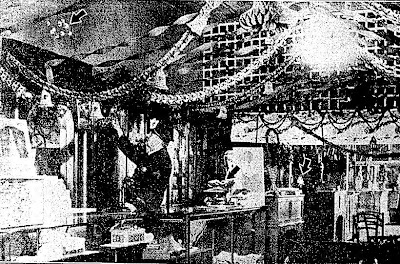
(Pictured: interior of the Aiello bakery after the Jan., 1928 shootout there. Arrows point to bullet holes in the walls and ceiling)

The summer of 1928 saw continued warfare between Aiello and Lombardo. In June, the bullet-riddled corpses of two Capone henchmen, John Oliveri and Joseph Salamone, were discovered at Death Corner, a half-block from the Aiello confectionary on Oak St. A month later, one of Aiello’s bodyguards, Anthony “Tough Tony” Califura, met his end in a drive-by shooting at North Ave. and Wells St. Four days later, an Aiello uncle was murdered in his Little Sicily grocery store, just south of Death Corner.

Finally, on September 7, 1928, Antonio Lombardo was murdered in broad daylight near the corner of Dearborn and Madison, in the full view of thousands of pedestrians. His killers escaped, but no one doubted that the Aiellos were behind the hit.

After the death of Lombardo, Joe Aiello saw an opportunity to finally gain control of the Unione Siciliana, but Capone and other allies managed to install Pasqualino Lolordo, a Lombardo associate, as president instead. To Joe Aiello, this simply meant one more bullet was needed, and in January, 1929, Lolordo was killed by three assailants while sharing drinks at his North Ave. apartment. At police headquarters, Mrs. Lolordo, who was preparing dinner in the adjoining kitchen at the time of the murder, was shown a photo lineup of potential assassins. She screamed when she saw Joe Aiello’s picture. While he was likely not one of the actual assassins (later evidence suggested the three assailants were Northside Gang members Frank and Peter Gusenberg, plus James Clark – all three later died in the St. Valentine’s Day Massacre), there was no doubt that Joe Aiello had organized the hit.

Finally, in 1929 and early 1930, most sources indicate that Joe Aiello finally did fulfill his long-time dream of becoming Unione Siciliana president. During this time, Al Capone was incarcerated in Philadelphia on weapons violations charges (he likely entered prison under his own volition as a way to protect himself from the spiraling violence on the streets of Chicago). For his part, Aiello spent much of his term as president hiding out in Northwest Indiana, a fugitive from police who wanted him for questioning regarding the Lolordo murder.

By late 1930, Aiello had returned to Chicago, but so had Capone, and old rivalries die hard. Joe Aiello was killed in an ambush on the far west side, near the Cicero border, on October 23 of that year. The rest of the Aiello family remained active in the underworld, eventually mending fences with the remnant of Capone’s organization, the Outfit, in the 1930s. In New York, the Aiellos are associated with the Bonanno organization, one of the “Five Families” in that city.

The old Aiello bakery remained in the family into the 1940s, serving as the headquarters for the San Giuseppi di Bagheria society, an Italian community organization focused on Bagherian immigrants (the locale in Sicily where the Aiellos originated). The building was destroyed in the early 1950s to make way for the Cabrini housing projects. In the 1990s, most of the major Cabrini-Green projects were razed, and replaced by upscale condominiums and mixed-income public housing. Where Aiello & Co. once baked wedding cakes and planned a takeover of Chicago’s bootlegging industry, a condominium building has recently been constructed.

Tuesday, September 30, 2008

The Pony Inn

Harry Madigan ran an Al Capone-controlled bar called the Pony Inn at this location, 5613 W. Roosevelt, Cicero, in 1926. In Spring of that year, the sidewalk in front of the saloon became the scene of a famous crime that haunted Capone throughout the rest of his career. The building still stands, now known as Sarno's Restaurant.

William McSwiggin was Assistant State's Attorney in Chicago, and had vigorously pursued an indictment against Al Capone in 1924 for killing Joe Howard in a South side bar. While unable to successfully prosecute Capone (despite the presence of several eye-witnesses), McSwiggin became known as a "hanging" prosecutor. But there was more to him than met the eye.

McSwiggin was also a card player, gambler, and drinker, and that naturally brought him into close contact with Capone and his associates on a regular basis. In fact, with the passage of time, Capone began to consider McSwiggin a friend. One night in late Spring, 1926, after dinner at his parents' house, McSwiggin and a few close friends went out for a night of gambling and drinks. Shortly after leaving the house, their car broke down and they ended up joining a couple of other friends in their car. These friends were the O'Donnell brothers, rival bootleggers who had a growing feud with Capone.

The O'Donnells' shiny new Lincoln went cruising through Cicero with McSwiggin and friends, hitting bar after bar, until they ended up here, at the Pony Inn, not far from Capone's Cicero headquarters. When word came to Capone that his rivals were encroaching on his territory, he sent a convoy of lieutenants, armed with machine guns, to make his displeasure known. No one told him his friend McSwiggin was with the group.

As the drinking party left the Pony Inn, bursts of gunfire sent fifty rounds into the group, killing three, including McSwiggin (the O'Donnells, the targets of the attack, escaped unharmed).

Public outcry at the gangland death of a state prosecutor pushed the police into action. Chicago police invaded Cicero, arresting Ralph Capone and raiding several Capone-owned joints. Al fled the city, spending the summer of 1926 among friends in the Italian community in Lansing, Michigan, until the heat died down enough for him to return to the Chicago area.

Never again, however, was Capone completely unmolested by the police. Though he had never intended to hurt McSwiggin, he had lost his standing with the public, who began to put increasing pressure on the police to shut down gang operations.

Monday, December 22, 2008

The 'Raiding Pastor' takes on Capone

Reverend Henry C. Hoover, a Berwyn minister, was the leader of a vigilante group known as the West Suburban Ministers' and Citizens' Association, and a constant thorn in Al Capone's side. As early as 1925, Hoover had identified Capone as a menace to society, and, together with his Association, paid off a rival group of gangsters to burn down one of Capone's brothels in Cicero, near the race track. These actions led Hoover to acquire the moniker, "The Raiding Pastor."

On May 16, 1925, Hoover set his sights on the Hawthorne Smoke Shop, a Capone-controlled gambling house, located here at 4818 W. 22nd St., in Cicero. His group raided the house early in the morning and toted out an array of gambling paraphernalia. When Capone heard about the raid, he personally marched over to the Smoke Shop (still dressed in pajamas) to find out what all the fuss was about. When he confronted Hoover, Hoover turned to a police officer who had accompanied him on the raid and asked, "Who is this man?"

Capone answered for him, using his common pseudonym: "I'm Al Brown, if that's good enough for you."

Hoover mocked the bootlegger, "Oh, I thought it was someone like that, someone more powerful than the president of the United States."

Hoover re-enacted this scene word-for-word on the stand at Capone's tax evasion trial in 1931, offering the jury the sacred word of a man of the cloth describing Capone's wickedness, and linking him to a known gambling operation. After this confrontation, Hoover explained that Capone had tried to cut a deal with the Raiding Pastor:

"Why are you fellows always picking on me? Reverend, can't you and I get together - come to an understanding? If you will let up on me in Cicero, I'll withdraw from Stickney."

Hoover responded righteously: "Mr. Capone, the only understanding you and I can have is that you must obey the law or get out of the western suburbs."

Damning as the testimony was, it never should have been heard in court. The raid was over five years old at the time of the trial, and Capone's attorneys could have had it excluded on statute of limitations grounds, had they realized it.

Rev. Hoover continued his crusades against organized crime until his passing in 1955.

Tuesday, November 11, 2008

Capone's Cicero Headquarters


Al Capone's Chicago headquarters were the Four Deuces, the Metropole Hotel, and later, the Lexington Hotel. But in Cicero, the town his syndicate owned, from the Mayor to the streetsweepers, business was chiefly transacted at the Hawthorne Inn, at 4833 W. 22nd Street.

After Capone's violent takeover of the town of Cicero in the election of 1924, he set up shop at the Hawthorne, fitting it with bullet-proof shutters and surrounding every entrance with battalions of armed guards. This was the true city hall in Cicero, the center of power, and when orders emerged from the Hawthorne Inn, even the mayor, Joseph Z. Klenha, jumped.

It was at the Hawthorne that Dion O'Banion began his double-crossing scheme, telling Capone and Johnny Torrio that he planned to leave the bootlegging game for greener pastures out West, leading to Torrio's arrest at Sieben Brewery, O'Banion's assassination, and Torrio's brush with death.

Having failed to kill Torrio, O'Banion's henchmen attempted to avenge their slain leader's life with a direct frontal attack on the Hawthorne Inn on September 20, 1926. On that date, Al Capone was eating lunch on the first floor of the Hawthorne. At 1:15 p.m., the sound of machine gun fire echoed through the restaurant, sending the waiters and patrons running out the back. Capone and his bodyguard hit the deck as a car passed by and the sound of bullets intensified.

Once the gunfire ceased, Capone arose unharmed and ran to the door, ready to get a good look at his assailants. Suddenly he noticed something odd: despite hundreds of bullets, not a thing was broken in the restaurant. The apparent drive-by shooting was a decoy, and only blanks had been fired, in an attempt to draw Capone out of the restaurant to his death. With this sudden realization, Capone's bodyguard tackled him, just as a caravan of seven Lincolns, headed by Schemer Drucci, Bugs Moran, and Hymie Weiss, passed by the Hawthorne, practically razing the hotel with machine gun fire. Almost 1000 shots were fired into the establishment, but again the Northsiders were frustrated: not one person, and certainly not Capone, was killed.

In retaliation, Capone ordered the hit on Hymie Weiss at O'Banion's flower shop, and the cycle of violence between the Capone Outfit and the North side gang continued to intensify.

The Hawthorne Inn remained open until 1970, and during much of that time, it remained a mob hangout. Today, the location is the parking lot for a bank.

Monday, January 19, 2009

Johnny Torrio and Al Capone's Accounts Receivable Department


The Torrio-Capone Outfit could have been entirely rolled up in 1924, if not for some behind-the-scenes legal wrangling and judicial payoffs.

After Chicago mayor William "Decent" Dever, the "dry" Democrat, shut down Capone's headquarters at the Four Deuces, the gang moved all their accounting operations to the second floor of a nondescript brick shopping center on the northwest corner of 22nd and Michigan, at 2146 S. Michigan. The photo above shows the location today (taken from the perspective of Michigan Ave.); see below for a newspaper photo of the scene at the time of Capone's residence (taken from the perspective of 22nd St.).

The shopping center was busy most of the time, and featured restaurants, offices, and dry goods, so for awhile, no one noticed the unusual activities in the physician's office on the second floor, where hung a sign reading "Dr. Frank Ryan" (some accounts claim the sign used Capone's favorite pseudonym, A. Brown, but this seems unlikely, given the gang's expertise at discretion) . A peak inside Dr. Ryan's office revealed an ordinary waiting room, furnished with various vials of medicines.

But beyond the waiting room were file cabinets upon file cabinets, containing the gang's accounts receivable records. There, Jake "Greasy Thumb" Guzik, the Outfit's chief accountant, kept ledgers detailing the assets, income and trade secrets of the largest bootlegging and prostitution ring in the world.

When Chicago police raided the doctor's office in April, 1924, and arrested Guzik, Frank Nitti, and Johnny Patton (the latter two were top lieutenants in the gang), they found ledgers showing major beer customers, locations of all speakeasies under Torrio-Capone control, details of the gang's liquor supply chain from Canada and the Carribean, corporate control documents for breweries owned and operated, and detailed T-charts for the suburban brothels in Stickney and Burnham. Embarrassingly, they also uncovered a list of police officers and federal agents receiving hush money.

The incredible findings were enough to shut down Torrio and Capone for good. As Mayor Dever told the newspapers, "We've got the goods now." Not only Chicago and Cook County authorities, but the Bureau of Investigation and the IRS in Washington prepared to examine the seized documents. William McSwiggin, the county attorney, was ready to empanel a grand jury.

Capone's men worked furiously behind the scenes. In Judge Howard Hayes, they found their man. Shortly after the raid, he summoned all seized records to his courtroom. The following day, without notifying McSwiggin, he returned all of these documents to Capone's attorneys, on the basis that the police had no search warrant for the accounting records, only for illegal liquor. A few weeks later, he dismissed all charges against the arrested men.

McSwiggin and the feds were infuriated at being outmaneuvered by Capone and undercut by Judge Hayes, but Capone remained a free man until 1931. After the raid, he relocated his headquarters to the Hotel Metropole across 22nd street.

Friday, April 3, 2009

Lookout Nest for St. Valentine's Day Massacre


The St. Valentine's Day Massacre, on the morning of February 14, 1929, established forever Chicago's international fame for brutal criminality, and turned the ire of an enraged city against its apparent mastermind, Al Capone, eventually leading to his downfall and imprisonment. Most historians believe, moreover, that the crime was essentially bungled by the lookouts, who occupied a rented room here, at 2119 N. Clark, across the street

This much is known: On the morning of February 14, 1929, seven members of the Northside gang, which was at the time led by George "Bugs" Moran (its former leaders, "Hymie" Weiss, "Schemer" Drucci, and Dion O'Banion having already been killed), arrived at the garage of the S.M.C. Cartage Company, a spot the gang often used for deliveries of illegal liquor. Moran himself was planning to join them that morning, but had not arrived yet.

When the lookouts across the street saw the men enter the garage, they gave the signal to a group of assassins, who drove two sedans equipped with sirens, intended to give the impression of police cruisers. Two men in police uniforms and two men in trenchcoats alighted from the vehicles and entered the garage, where they apparently used machine guns to fire off over seventy rounds, killing six of the Moran gang members immediately in the bloodiest murder scene in Chicago's history. The dead were Pete Gusenberg, a street-level tough for the Moran gang, John May, a mechanic who worked with the gang, James Clark and Adam Heyer, two ranking members of the gang, Albert Weinshank, a labor racketeer who organized laundry businesses for the gang, and Reinhart Schwimmer, an optician who was associated in various gambling operations with Moran. A seventh man, Frank Gusenberg (Pete's brother), lived for another three hours before expiring in the hospital.

After the shooting, the two men in police uniforms marched out of the garage, pointing their guns at the two men in trenchcoats, who held their hands above their heads until they re-entered the cars they arrived in and drove off.

That much is known. Who precisely the shooters were, and why they committed the crime probably will never be known.

The most common theory is that "Machine Gun" Jack McGurn, one of Capone's lieutenants, conceived the plan as a way to kill Moran, eviscerate the Northside gang's rival liquor operations, and to retaliate against the Gusenberg brothers for a previous attempt on McGurn's life. Under this theory, McGurn hired Harry and Phil Keywell, two members of the Purple Gang, a vicious Detroit-based operation, to rent rooms at 2119 N. Clark St., and to operate as lookouts. When the six men arrived, the Keywells, who knew Moran only from newspaper photos, mistakenly believed Weinshank was Moran, and gave the signal to attack.

The photo below shows Clark Street at the time of the Massacre. The short building on the left side of the street marked with an 'X' is the garage where the murders took place; the tall building also marked with an 'X' in the foreground is the building at 2119, the lookout nest.


According to the most common theory, the Capone syndicate's two favorite assassins, John Scalisi and Albert Anselmi, who had risen to power in the Genna operation and had previously been involved in the Weiss and O'Banion killings, were among the four assassins, along with Fred Burke, a hired killer from the Egan's Rats gang in St. Louis, and another man, possibly McGurn himself or future Outfit leader Tony" Joe Batters" Accardo, but more likely Joseph Lolordo, who was the brother of the Unione Siciliane president Pasqualino Lolordo, who had recently been assassinated by the Northsiders.

Moran, who had overslept that morning, arrived on the scene late, saw the police cars, and fled the scene, avoiding death by a few minutes.

Al Capone himself was in Miami at the time, conveniently being questioned by that city's district attorney on gambling-related matters, providing a perfect alibi. McGurn claimed to have been with his girlfriend, Louise Rolfe, in a hotel room at the time. After the police determined he was the mastermind of the murders, they attempted to make Rolfe testify against McGurn in court, but were outwitted when, in a dramatic turn frequently repeated by criminals on Law and Order and CSI, McGurn married Rolfe, allowing her to claim spousal privilege against testifying. Seven years and one day after the Massacre, McGurn was assassinated in a bowling alley, and a sarcastic "Valentine's day card" was pinned to his dead body.

Fred Burke was connected to the crime when, several years later, he was arrested for a murder in Michigan. When the police tested two machine guns found in his home, the ballistics matched the bullets found at the St. Valentine's Day Massacre. Burke was sentenced to life in prison for the Michigan murder, but never served time for the Chicago killings.

While the above describes the most common theory of the Massacre, there have been endless revisionist histories. Some claim that Capone and McGurn would have been too smart to attract attention to themselves with such a sensational crime, and that the Purple Gang was entirely responsible, retaliating against Moran for failure to pay them for liquor they had imported from Canada to be sold in Chicago. Others claim the hit was Capone syndicate labor racketeering leader Curly Humphrey's idea, and that Moran was not the target at all. Instead, Albert Weinshank, who was standing in Humphrey's way in monopolizing the city's lucrative laundry business, was the intended victim. The "valentine" pinned onto Jack McGurn's body after his killing made a oblique reference to laundry.

The true killers and motive will probably never be known with certainty, but at the time, all fingers pointed at Capone, either as the mastermind of the plan, or at least a silent assenter to McGurn's plot. After the sensational killings, Capone's reputation truly became international, attracting constant attention from the press, the police, and worst of all, the IRS. If it wasn't for the St. Valentine's Day Massacre, Capone probably would have continued to fly under the radar for at least a few more years (Capone was, in actuality, a sick man who had only a few years left before senility took hold). Instead, the tax revenue men took aim at Capone's gambling operations and imprisoned him in 1931, ending his career as a gangster.

While the S.M.C. Cartage garage, where the killings took place, was razed in the late 1960s, the lookout house at 2119 N. Clark still stands. Over the years, it has remained a rooming house with a restaurant at street level. One of Chicago's first sushi restaurants, Samarai Sushi, opened there in the early 1980s, and an Italian restaurant occupies the space today.

(Pictured: the S.M.C. Cartage garage at the time of the Massacre, with a crowd of curious onlookers)

Saturday, May 30, 2009

Antonio Lombardo Killed in the Loop


In 1925, Antonio Lombardo became president of the Chicago chapter of the Unione Siciliana, a community and political organization of immigrants. In those days, the presidency of that organization was one of the most profitable -- and dangerous -- jobs in the world, and danger caught up with Lombardo on September 7, 1928 near the corner of Madison and Dearborn Streets in one of the most spectacular mob hits of all time.

Tony Lombardo was born in Sicily in 1891, and came to Chicago as a teenager. He built a successful grocery business as a young man, and in so doing, elevated his political profile in the impoverished neighborhoods of his countrymen, including Little Sicily/Little Hell on the north side and the 19th ward on the west side. Lombardo was an associate of the "Terrible" Genna family, which controlled the dispersed network of home distilleries, mostly operated by Sicilians, which supplied the Johnny TorrioAl Capone syndicate with product during the Prohibition years. Lombardo's wholesale grocery had the lucrative position of supplying bulk sugar (one of the main ingredients in home “alky-cooking” for the Genna network.

(Pictured: Antonio Lombardo)

Lombardo’s partners in the grocery business included Joseph Ferraro and Joseph Aiello. Aiello, one of a large family of brothers that ran a bakery and a candy shop in Little Sicily, was particularly ambitious in growing the enterprise. Lombardo and Aiello operated a major wholesaling operation on Randolph Street near Aberdeen, of which Lombardo made Aiello president.

In 1926, the two, along with Ferraro, purchased land on Kinzie St., between Halsted and Green streets from an old steel yard, intending to open a fruit market. By that time, Lombardo was known as a major figure in the underground liquor trade, having been recently involved in a high-profile case involving abuse of licenses granted to synagogues for sacramental wine. The Tribune reporter included a wink and a nod in the story noting the real estate transfer:
A wholesale fruit market, with an accent on grapes (what does this mean, Watson?), is to be opened by Giuseppi Aiello, Antonio Lombardo and Joseph Ferrara, on an irregular shaped piece of property fronting seventy-six feet on Halsted street, 125 feet on Green street, 252 feet on Kinzie street and 252 feet on a paved court.
The three bought the property, which is now covered by the Kennedy Expressway, for $176,799, with a down payment of $45,000. It was shortly after this that Aiello and Lombardo fell out over Aiello's ambitions for greater control in the business (later, a lien would be placed on the property when Aiello failed to pay his share of the mortgage). Aiello also coveted the presidency of the Unione Siciliana, a position Lombardo held at that time.

(Pictured: Letterhead for Lombardo grocery concern on Randolph St., with Aiello listed as president)

The death of Unione president Mike Merlo in 1924 led to the assassination of Dion O’Banion, likely at the orders of Capone and Torrio, and in the subsequent bloodshed, the city’s bootlegging business was divied between rival gangs, with Capone and Torrio controlling the south side and Cicero, and O’Banion’s followers “Hymie” Weiss, George “Bugs” Moran, and Vincent “Schemer” Drucci taking hold of the north side. Lombardo and the Gennas worked with the Torrio-Capone syndicate, with Angelo Genna succeeding Merlo to the presidency of the Unione.

When Angelo Genna was killed in 1925, Sam “Samoots” Amatuna became president of the Unione, but only for a brief period before he, too, was assassinated. Then, it was Lombardo who became “Don” to the city’s Sicilian population. The presidency of the Unione Siciliana, which claimed 15,000 members, involved substantial political influence over an important voting bloc, and so it created the opportunity for the one who held that position to become a “fixer” with connections in city hall. Control of the Unione was thus highly important for the Capone bootlegging business, which relied not only on the network of Sicilian amateur distillers which pledged their loyalty to the Unione president, but also on Unione-connected politicians and police officers to look the other way, or even work proactively against competitors. The Unione presidency was also an position of great community esteem, prominent in resolving disputes and feuds among Sicilians, including “Black Hand” extortion plots, which were especially problematic at that time. Thus, Lombardo was a real-life Chicago version of Vito Corleone.

However, the connection between the Unione and organized crime had become fixed in the public’s mind, and Lombardo sought to change this impression by renaming the Chicago chapter as the "Italo-American National Union" and allowing non-Sicilian Italians to join. The name change angered some, including the president of the New York branch of the Unione, powerful mobster Frankie Uale.

The Italo-American National Union also contributed prominently to charities, including, for example, hurricane relief in Florida in 1926. It attempted to raise its profile as a leading civic organization by inviting important Italian politicians to Chicago. At the time, Benito Mussolini had recently consolidated control of that country, and so Lombardo brought Mussolini’s U.S. ambassador to Chicago for a prominent series of speeches promoting fascism:
God sent Benito Mussolini to an imperiled Italy and did, thereby, a service to all the world, Baron Giacomo de Martino, Il Duce's ambassador to this country, yesterday declared three times during the first day of his three day visit to Chicago. And three times yesterday groups of the ambassador's countrymen, once at the Italian Chamber of Commerce luncheon at the Drake, again at the Italo-American union massmeeting at the Coliseum, and last at the union's dinner at the Palmer house -- jumped to their feet and cheered mightily as they shot out their right arms in the Roman salute of Fascism.
After his falling out with Lombardo, Joseph Aiello allied himself with the Northsiders, Weiss, Moran, and Drucci. Aiello knew that, with control of the Unione, the North side gang could take control over the entire Chicago alcohol business, and reap hundreds of millions of dollars in profits. He also coveted the social standing that Lombardo held in the Sicilian community, and the jealousy made him murderous.

In one instance, Aiello allegedly offered $35,000 to a chef to poison Lombardo and Capone. In another case, he offered Torrio-Capone ally Ralph Sheldon $50,000 for each of the heads of Capone and Lombardo. Capone offered peace to the north side gang by offering to divide the city along Madison street, which led to a brief ceasefire, but before long, Aiello’s ambitions on the Unione presidency, and Lombardo’s ruthlessness in maintaining it, led to more bloodshed.

Early in 1927, police uncovered a stash of weapons and ammunition in a sniper nest across the street from Lombardo’s home on W. Washington St., near Cicero Ave., and a similar one at the Atlantic hotel, across from Alderman Michael “Hinky Dink” Kenna’s post-Volstead headquarters on Clark St., where Capone and Lombardo were frequent visitors. When Lombardo realized the extent of Aiello’s bloodlust, he moved his family out to a more easily guarded single-family home on S. Austin Blvd. in Cicero. But he knew that eventually either he or Aiello would meet an early grave.

After the discovery of Aiello’s weapons caches, the police arrested him on weapons charges and placed him in a cell at detective headquarters. In the adjoining cell they placed three Capone gunmen who had also been caught with illegal weapons while searching for Aiello, and a police officer who spoke Italian hid nearby, listening in on the conversation. The officer’s report refers to Capone’s frequent alias, Al Brown:
"Can't we settle this thing?" Aiello then pleaded with the trio. "Give me fifteen days, just fifteen days, and I will sell my stores and my house, and leave everything in your hands. Think of my wife and my baby, and let me go."

The Brown [Capone] gangsters gazed at their subdued foe scornfully and replied, according to the listening policeman:

"You dirty rat, you started this thing. We'll end it. You're as good as dead now."
Nevertheless, Aiello did manage to escape after the incident, and fled to New York, where he remained for a year, no doubt spending plenty of time commiserating with Frankie Uale about their shared dislike for Lombardo.

With Aiello out of town, Lombardo relaxed his guard, and even helped Capone go on the offensive. When, in November, 1927, the gang discovered north side gambling operations on Monroe St., two blocks south of the Madison Street border, bomb explosions there served as a "final warning." When questioned by a reporter about the bombings, Lombardo replied:

"Me, a bomber? Go to the people who know me best. Ask the Italians of Chicago if I am a bomber. Find one of them who will say I am a criminal. You can't do it."

It’s unclear whether this was supposed to be exculpatory, or simply a statement of Lombardo’s absolute power in the Sicilian community.

(Pictured: Antonio Lombardo)

By 1928, Joseph Aiello was back in Chicago, and again plotting a takeover of the Unione Siciliana. Lombardo still stood in his way, but not for long. On September 7, 1928, at 4:30 p.m., Lombardo, his long-time business partner Joseph Ferrara, and a bodyguard, Joseph Lolordo, stepped out of the offices of the Italo-American National Union in the Hartford Building at 8 S. Dearborn St. They walked north towards the corner of Madison St., where a large crowd had gathered. Across the street at the Boston dry goods store, an airplane was being dragged up the side of the building up to the 11th floor by ropes, and into a window, for a store promotion. Practically everyone on the scene was focused on the unusual sight -- everyone except two mysterious men from out of town, dressed in dark gray suits.

50 feet west of Dearborn, on the south side of Madison st., at the corner of the Hartford building, and just in front of a Greek restaurant, Tony Lombardo turned to his bodyguard.

“Look at the airplane,” he pointed across the street.

At that moment, the two men in gray appeared out of the doorway of the Greek restaurant, ran up behind Lombardo, and unloaded their revolvers into the Unione president’s head, also shooting Ferrara in the back, before dropping their guns at the scene and running east on Madison. Lombardo’s bodyguard, Joe Lolordo, took off running after them, while the panicked crowd of bystanders scattered.
Gunmen and policemen ran here and there with waving guns, men and women in the crowded street jumped first one way and then another, wondering from which direction the next bullet might come. People in stores ran out, then ran back in. Which way safety lay they could only guess.
A police officer tackled Lolordo, thinking he was one of the assassins, while the real assassins ducked into a nearby shoe store, exiting out the back and escaping the chase. Antonio Lombardo, president of the city’s largest Italian group and a major underworld figure, died on the street, shot to death in broad daylight in front of thousands of witnesses at one of the city’s busiest intersections. In the photo at the top of this post, the spot of the shooting is on the sidewalk, roughly at the right-hand end of the wooden scaffolding.

(Pictured: scene on the street at the site of Lombardo's shooting)

A week later, Ferrara also died of his wounds. Following underworld protocol, he refused to cooperate in the police investigation of the shooting before his decease, but based on identification by another eyewitness, Frank Marco, a New York hoodlum and a known acquaintance of Aiello’s, was charged with the crime. Marco wasn’t located, however, until his bullet-riddled body was found on E. 19th street in New York City in February, 1930. No one else was ever charged with the crime, but everyone assumed the hit must have been ordered by Aiello, possibly with the assistance of Frankie Uale’s gunmen from New York.

After Lombardo’s death, his bodyguard's brother, Pasqualino Lolordo, took over the presidency of the Unione, until Lolordo, too, was shot and killed at his home in January, 1929. According to most sources, Aiello finally did become president of the Unione Siciliana for about a year while Capone was in prison in Philadelphia on weapons charges. But when Capone returned to Chicago in 1930, Aiello made plans to flee the country; however, a sniper's bullet found him first.

The Hartford building, where Tony Lombardo’s Unione Siciliana headquarters were on the 11 floor, and in front of which he was killed, was built in 1893. Standing at 14 stories, it was one of the city’s tallest. It was destroyed, along with all other buildings on the same block, in 1965 to make way for the First National Bank Building, now called Chase Tower.

Monday, December 22, 2008

Capone's Soup Kitchen


By late 1930, the U.S. attorney's office had obtained income tax-related convictions against Ralph Capone and Frank Nitti, two of Al Capone's right-hand men, and it was obvious their next target was going to be Big Al himself. The famous racketeer decided it was time to manufacture some good publicity for himself, and the onset of the Great Depression offered him the perfect opportunity.

With thousands laid off from their jobs and the economy worsening, Al Capone turned himself into a one-man relief operation, feeding over 1,000 of Chicago's hungry every night at his own soup kitchen, located here at 935 S. State St.

The building was located deep in one of the city's poorest and most crime-ridden neighborhoods (a hardboiled 1921 Tribune article describes a valorous police officer who shot and killed a transvestite who had tried to to attack the officer and steal his gun at this address), and on Thanksgiving Day, 1930, Capone triumphantly fed 5,000 of the neighborhood's neediest.

The press ate it up, and those who dined on Capone's dime supplied the newsmen with plenty of quotes about how this bootlegger was doing more for the impoverished than the entire U.S. government. Capone's federal pursuers were furious at the development, and ordered even closer watch on his activities, raiding the Cicero hangout the week after Thanksgiving.

While Capone received an enormous amount of positive publicity for his efforts, Bergreen notes that much of the food may have come from local merchants who were blackmailed or otherwise coerced into supplying it. Then again, does the government do it any differently?

Nevertheless, it was all to no real avail. By June, 1931, Capone had been indicted for income tax evasion, and by October, he was in prison, where he stayed for the next eight years.

The building remained a flophouse for the next 25 years, until the city shut it down for fire code violations in 1955. Today, all that remains is a parking lot.

Wednesday, March 11, 2009

Al Capone Arrested for DWI


After growing up in the Italian slums of Red Hook, Brooklyn, Al Capone briefly worked as an accountant in Baltimore. But in 1921 when his old friend from New York, Johnny "The Fox" Torrio, called and offered him work in his Chicago crime syndicate, Capone jumped at the opportunity.

The advent of Prohibition created opportunities for enterprising and intelligent men to make a fortune in the underworld, and Capone was just that type of man. Upon his arrival in Chicago in 1921, the future gang leader was first tested by Torrio with street-level enforcement work at the Four Deuces and organization of a prostitution enterprise in Rogers' Park. But with his business acumen and willingness to employ violence, Capone quickly climbed the corporate ladder, and he became Torrio's closest business partner within a year.

It was at this point that Al Capone first came to the attention of the Chicago police department, when, intoxicated, he slammed one of Torrio's cars into a parked taxi cab at the corner of Randolph and Wabash, pictured above. The story in the Tribune, reprinted below in full, tells what happened next:

Capone was right. Torrio's "pull" within the police department, as evidenced by his phony sheriff's badge, kept Capone out of prison. Needless to say, if Capone had been sentenced for his DWI in 1922, the entire course of the 1920s in Chicago would have been different.

Monday, December 8, 2008

Fred Ries, or How Cockroaches Brought Down Scarface

Fred Ries was the cashier at several Capone-controlled gambling operations, including the "Subway", at 4738 W. 22nd St., in Cicero, located where the building pictured above now stands. In large part because Ries was entomophobic (afraid of insects), Jake Guzik, Frank Nitti, and Al Capone ended up in federal prison.

Ries' job as cashier involved collecting the house's winnings each night, converting them into cashier's checks, and then passing cuts of these checks to the Capone Outfit's leadership, including "Scarface" himself. This laundering scheme kept any evidence of income (and thus, tax liability) safely separated from Capone and company. The feds knew Al had plenty of money -- they had seen him lose $20,000 in a night of gambling, plus his substantial real estate holdings -- but they had no way to prove he had earned it as income. Until, that is, they found out that one of Capone's cashiers was deathly afraid of cockroaches.

At the time of his arrest as a material witness, federal agents found Ries hiding out in St. Louis. They threw him into a specially-made cell in Danville, Illinois, which had previously been prepared with roaches, spiders, rats, and bedbugs. After five days in the cell, Ries was ready to talk. He would have done anything to escape that cell.

Based on his grand jury testimony, Guzik, Nitti, and Al Capone were indicated for tax fraud. Of course, during the time between the indictment and the trial, Fred Ries became the #1 mark for Capone's henchmen, which is why the feds sent him on an all-expenses-paid vacation to South America for a month. At trial, Ries' testimony was the coup de grace, the government's final and most convincing witness, tying Al Capone directly to substantial sums of income on which he had never paid taxes.

Capone went to prison for eight years, effectively ending his racketeering career. Ries went into hiding, and apparently was never heard from again.

Fred Ries' operation, the Subway, sat on property which is now the location of a Dunkin' Donuts store (currently being renovated).

Capone's Horse Track

As with pretty much everything else in Cicero, Al Capone took control of the Hawthorne Race Track early on, and the fix was frequently in.

Lawrence Bergreen quotes a photographer for the Evening American, who claims that Capone used the fix to bribe him:
Assigned to cover a horse race at the Hawthorne track Capone controlled, Berardi was surprised to find Al himself at the race that day, accompanied by his usual retinue of five bodyguards. "Kid, how you doing?" he called out.
"I'm doing fine," said Berardi.
"Why don't you bet on number 6?"
The odds against the horse Capone recommended were exceedingly long: ninety-nine to one. Before Berardi could reply, one of Capone's attendants rushed over and stuffed a slip of paper in his jacket pocket. "I looked at it," Berardi rememberd, "and it was a five-dollar ticket on this number 6 horse....Well, he broke out in front and stayed out in front, and I don't think anyone dared catch him. The goddamn horse won by a block....Capone didn't bribe me; he just put $300 in my pocket.
(Bergreen, Lawrence, 1994, Capone: The Man and the Era. New York: Simon & Schuster, pp. 150-151).

Most of the Hawthorne track burned down in 1979, and a larger track was rebuilt afterwards.

Tuesday, October 7, 2008

Ralph Capone's Home


That is not Ralph Capone's 1996 Dodge Grand Caravan. That is, however, Ralph Capone's house behind it, at 1924 S. 49th Ct., in Cicero.

Born Raffaele Capone in Naples, he immigrated to New York with his parents in infancy, and came to Chicago about a year after his brother, Al. For awhile, he helped Al run a call flat in Rogers' Park, working for the Johnny Torrio syndicate. Later, Ralph became the right-hand man of that organization when Al took over, and ran the entire organization during period when Al was in jail or otherwise away from Chicago. During the salad days of the Capone bootlegging operation, "Bottles", as Ralph was known, organized the distribution of liquor, and also ran several speakeasies and brothels, including the famous Cotton Club in Cicero.

Ralph also became the government's test case in prosecuting racketeers for income tax evasion. Never as smart as his brother, government prosecutors noticed that practically all of Ralph's bank deposits were in multiples of 55, notable since the going rate for a barrel of beer was $55. In addition, after his indictment, Ralph continued operating his distribution business, never considering that his telephones might be tapped. Ralph Capone was the first racketeer to serve a prison sentence for tax evasion. He spent three years at McNeil Island Corrections Center in Puget Sound before being released in 1934.

After release, Ralph continued his job in the Capone organization, working for Frank Nitti, since Al was, by that time, in prison. The government continued to dog Ralph throughout the rest of his life, primarily on income tax charges, although he never went back to prison, and eventually retired to Mercer, Wisconsin, where he died in 1974.

Saturday, August 30, 2008

Capone's Chicago Headquarters


Johnny Torrio, the second great gang leader of Chicago, ran a tough dive called The Four Deuces, located where this empty lot now stands, at 2222 S. Wabash. After taking over leadership from "Big Jim" Colosimo, Torrio consolidated prostitution, gambling, and liquor operations throughout the city. He also hired a young Brooklyn-born gangster named Alphonse Capone, who had recently arrived in Chicago. Torrio himself was from Brooklyn, and had known Capone when the latter was a boy. Thus, he trusted "Scarface" to run some of his cribs and collect protection money. So effective and brutal was Capone's reputation on the streets of Chicago, that he was quickly elevated to the post of manager of the Four Deuces, and this remained Capone's headquarters after Torrio left Chicago.

In 1924, Capone moved his headquarters a few blocks west to the luxurious Hotel Metropole at 2300 S. Michigan, currently being developed as a condominium, where Capone's gang controlled two floors and sixty hotel rooms, patrolled at all times by heavily-armed gunmen. The basement of the Hotel held $150,000 worth of wine and liquor at the height of national Prohibition.

The site of the Metropole is currently being redeveloped as a condominium.

Tuesday, January 5, 2010

Death of Jake Lingle

During the 1920s, a series of increasingly spectacular acts of violence enraged the public and each led to at least a short-term increase in police enforcement against criminals. But none was so prominent and far-reaching as that which followed the murder of Jake Lingle, Chicago Tribune reporter, close to here in the tunnel under Michigan Ave. at Randolph St., on June 9, 1930.

By raising the price of alcohol, while doing little to reduce the public’s demand for it, Prohibition had served to enrich those who were still willing to produce and sell. It also put the industry in the shadow of the law, and so created the incentives and opportunities for violence. Thus, the 1920s were the era of big-spending, flashy gangsters and headline-splashing murders, epitomized by the St. Valentine’s Day Massacre in 1929. By 1930, that epoch was coming to a close. The stock market crash of the previous October and the rapidly worsening economy dampened the demand for booze, and the shrinking government revenues from income and sales taxes produced a political demand for new sources of tax revenue – and liquor was high on the list of potentially lucrative targets, if only it was legalized. Within three years, Prohibition was repealed, and its personification, Al Capone, was rotting away in prison. The .38 caliber revolver shot that killed Lingle symbolized the end of the golden age of the Chicago gangster.

Alfred J. Lingle was born of modest means on Chicago’s west side in July, 1891, the son of a small business owner. Lingle’s great talent lay in his personality: he was a “character” not easily forgotten, a warm, self-possessed fellow, and an easy confidant. Born a Jew, his family converted to Roman Catholicism when he was eight years old, meaning he could easily fit in with a variety of ethnic groups. Lingle was also fascinated with police work from a young age, and he would frequently haunt police stations and crime scenes, peppering detectives with questions.

After attending the John Calhoun North school at Adams and California streets (the school still operates today), Lingle first took a job as a stocker at the Schoelling Company, a surgical supply house. He also played semi-pro baseball for a short time. But it was not long before his talents and interests found him in a job as a crime beat reporter at the Chicago Tribune, where he first started work in 1912.

In those days, men like Lingle, who had progressed no farther than 8th grade in school, were paid to gather news on the street and feed it back to specialist writers who organized the facts and wrote the purple prose. Hence, Lingle typically had no byline, but his reporting laid the foundation for most of the big crime stories at the paper during the 1910s and 1920s (except during WWI, during which Lingle served as a Navy intelligence officer). One of his first assignments was to cover the closure of the south side “Levee” (open vice) district during 1912-13.

Lingle was successful in his work because of his ability to mix with the criminal element, and he was on familiar terms with all of the top racketeers of his period. Mossy Enright, Tommy Maloy, James Colosimo, Johnny Torrio, and Al Capone all counted Lingle as a friend. After his death, Lingle’s relationship with Capone would come under particular scrutiny. Lingle had, on several occasions, procured exclusive interviews with Capone, and “Big Al” had even gifted him with a $300 diamond-encrusted belt buckle, which he wore proudly.


(Pictured: Jake Lingle)

Lingle was also close to many political figures and top police brass in the city. A childhood friend was William F. Russell, who became police commissioner in 1928 after scandals erupted surrounding the previous office-holder, Michael Hughes (described in this post). Some say that Lingle, through his various power connections, actually had a hand in lobbying for, and promoting Russell to the position. Lingle even had a joint stock investment fund he ran with Russell. Lingle’s close relationship with Russell (and his propensity for braggadocio) caused others to only half-jokingly refer to him as the “unofficial chief of police.” Many other key city officials, bureaucrats, and patrolmen were also among his friends.

But it’s possible to have too many friends. Lingle’s social network made him an ideal “fixer,” someone who could make deals between the underworld and those who were tasked with eliminating it. In time, the opportunities to put in a good word in City Hall for this or that gambling joint, to pass along a tip about an upcoming raid to some brothel proprietor, and to broker deals between speakeasies and the patrolmen on their beat, became too great for the $65-per-week newspaper stringer.

Like a great many others in the 1920s, Lingle also participated in the bull stock market of that decade. His bank records indicate he amassed over $85,000 in capital gains at the height of the frenzy. But, also like many others, he took a bath on Black Tuesday in October, 1929, losing most of his fortune and diving deeply into debt. But is was hard for Lingle to relinquish the lifestyle his underworld earnings and investment riches had brought him. It wasn’t easy to give up the vacations in Cuba, the high-rolling afternoons at the race track, and his luxurious suite at the city’s top hotel, the Stevens on Michigan Ave. (now the Chicago Hilton). Then there was his wife, Helen Sullivan, and their two young children, Alfred Jr. (born 1924) and Dolores (born 1925), who Lingle worshipped. He had recently put down $18,000 on a family vacation home in Indiana.

Thus it was that Jake Lingle increased his involvement with the criminal element. Where there was money to be made, he made it. To supplement that income, he even began double- and triple-crossing his acquaintances, working simultaneously as an agent for the police, politicians, and rival gang syndicates. Friends became enemies and enemies friends.

On the morning of June 9, 1930, Lingle left his in-town suite at the Stevens Hotel and, after stopping in at Tribune Tower to chat with his editor, he set out for the nexus of politics and crime in Chicago at Clark and Randolph streets, to see what choice tidbits he could pick up from the gamblers and sharpies who made that corner their headquarters. Next, it was a round of gladhanding and small talk with other power brokers in the lobby of the Sherman House hotel. Satisfied that he’d completed his work there, he walked east to Michigan Ave. At the corner of Randolph St., he purchased a newspaper and a horseracing publication and entered the underground tunnel leading to the train station on the other side of Michigan Ave.

The 1:30 train to Homewood was leaving in a few minutes and Lingle expected to spend the afternoon at the Washington Park Race Track. He was a big-spending gambler on the ponies, sometimes placing up to $1,000 on a single sprint. He was close with many horse owners and jockeys, and sometimes had inside information he used to turn the odds in his favor. The turf was also a great place to chat up those in the know in gangland, picking up tips he could pass on at the Tribune. So the afternoon gambling junket wasn’t purely a matter of pleasure.

As he walked through the tunnel, he lit a cigar, unaware of two men who trailed him in from the street. As he approached the far east end of the tunnel, one of them, a thin man with dark eyes and blond, wavy hair, pulled up behind Lingle and fired a single bullet into the back of his head. Lingle’s jaw clamped shut on the cigar and he fell face-forward to the ground, instantly dead.

His shooter and accomplice took off back through the tunnel, then suddenly, the man with blond hair who had fired the gun turned back and ran past Lingle’s body, leapt a railing at the train station entrance, and climbed up to the east side of Michigan Ave. Hot on his tail at this point were several by-standers who had watched in terror as the scene unfolded. Reaching the surface, they called out to a police patrolman, Anthony L. Ruthy, “Stop that man!” Officer Ruthy chased the killer across Randolph, then westward on the north side of the street across Michigan and into an alley which made a left turn and emptied onto Wabash St. At the corner of Wabash and Randolph, the shooter disappeared into the crowd and made a getaway from his pursuers. Later it was learned he entered the Taylor Trunk Company at 23 E. Randolph, nervously purchased a $5 hat, asked to use the restroom, and then left the store without his hat.

The gangland-style shooting of a humble and presumably honest news reporter with a wife and two children shocked the city. Here was a man who, to the public, appeared to have no gang affiliations, and killed in cold blood. If it could happen to him, it could happen to anyone. Public pressure to find Lingle’s killer and to rid the city of criminal gangs once and for all was intense.

Within 24 hours, the police rounded up 664 “wise guys” into the city bridewell, and an unsurpassed manhunt blanketed the Chicago area. One enterprising judge, John Lyle, used the opportunity of public outrage to issue largely unconstitutional, but ingenious, arrest warrants for “vagrancy” to top gang leaders, including Al Capone, on the theory that if they paid their bail, then they could be questioned on the source of their income and either imprisoned or investigated for tax evasion. Almost all of these efforts ended in little more than a waste of police and court resources, though a few notable criminals did fall into the dragnet, including labor racketeer George “Red” Barker, and Joseph Traum, an Indiana desperado. Another fallout from the killing was the resignation, under intense political pressure, of Lingle’s friend in the police force, Commissioner Russell, as well as several other top police brass.

Immediately after the killing, partially out of sympathy and partially for headline-grabbing purposes, Lingle’s employer, the Tribune, posted a $25,000 reward for information leading to the capture of his shooter, and other city papers added an additional $30,000 on top of it. When, a few days, later, however, competing papers began learning – and printing – the details of Lingle’s close associations with mobsters, his political “fixing” activities, and his lavish lifestyle and gambling habit, the Tribune maintained that no one at the company was aware of any of Jake Lingle’s darker side. In fact, Lingle had frequently bragged about his friendships with gangsters, although he also told friends that he had inherited hundreds of thousands of dollars from wealthy relatives.

Frank Wilson, an IRS agent investigating the Capone case, claimed in his autobiography that Col. Robert McCormick, proprietor of the Tribune, had personally arranged a meeting between Lingle and Wilson, scheduled for the day after the murder. If true, this implies that McCormick was well aware of Lingle’s underworld connections; however, McCormick always denied the accusation, and other sources claim that Wilson only contacted McCormick after the murder.

In any case, Lingle’s death created a scandal for the paper. Mayor William Hale Thompson, a long-time target of the paper’s editorials, took the opportunity for a pot shot at the Tribune, referring to it jokingly as the “Lingle Evangelistic Institute.” The Tribune tried to quash the furor by separating themselves from Lingle; they even published Lingle’s entire checking account register in a full two-page spread in an attempt at openness – while at the same time covering up what anyone at the paper might have known about the large and frequent sums entering and exiting the account. In an exculpatory editorial, the paper wrote,


Alfred Lingle now takes a different character, one in which he was unknown to the management of the Tribune when he was alive. He is dead and cannot defend himself, but many facts now revealed must be accepted as eloquent against him.

He was not, and he could not have been, a great reporter. His ability did not contain these possibilities. He did not write stories, but he could get information in police circles. He was not and he could not be influential in the acts of his newspaper, but he could be useful and honest, and that is what the Tribune management took him to be. His salary was commensurate with his work.

The reasonable appearance against Lingle now is that he was accepted in the world of politics and crime for something undreamed of in his office and that he used this in undertakings which made him money and brought him to his death. He has paid the penalty of it if he was enticed into this pool and the Tribune regrets it for the boy’s sake and for the sake of the profession.

The occurrence, although not unusual, is always tragic.
The Tribune also helped fund the investigation into the killing by the State’s Attorney’s office, contributing office space and the services of their corporate counsel, Charles F. Rathbun. Rathbun’s presence on the investigative team also helped insure that evidence unfavorable to the paper never saw the light of day. Pat Roche, lead detective in the State’s Attorney’s office, and Rathbun, lead a year-long focused manhunt for Lingle’s killer, which took them on investigative journeys as far as Havana and Los Angeles.

So who killed Jake Lingle, and why? The answer remains shrouded in mystery after 70 years, but here are the known facts. Lingle’s killer dropped his revolver at the scene of the crime. The serial number on the weapon had been filed down, but careful forensics were able to recover it, and the gun was traced to a sale at the sporting goods dealership of Peter Von Frantzius at 608 W. Diversey Pkwy. Frantzius was a popular arms dealer to the underworld, and his shop had also supplied the weapons used in the St. Valentine’s Day Massacre.

Von Frantzius’s records showed the firearm had been sold to Frank Foster (born Frank Citro), known to police as a member of the Northside Gang, although there were indications Foster had recently switched sides, becoming a gunner for the rival south side Capone syndicate. Foster was arrested in Los Angeles on July 1, and extradited to Illinois.

Upon seeing Foster, several witnesses, including Officer Ruthy, who chased the shooter through the Loop, declared he was the killer. However, other witnesses disagreed, and Foster had a reasonably plausible alibi. The State’s Attorney’s office suspected he was not their man, but kept him in legal limbo while they continued their frantic search.

Finally, based on underworld gossip and a close resemblance to the witness descriptions, police arrested one Leo V. Brothers, a member of the St. Louis-based Egan’s Rats gang, which was a Capone affiliate in that city. Brothers was a labor union slugger, and was wanted in connection with a murder that took place during struggles between rival factions of a taxi drivers’ union. He had escaped to Chicago with a recommendation to one of this city’s top labor racketeers, Thomas Maloy, and had found work as a bouncer at the mob-controlled Green Mill saloon on Broadway and Lawrence Aves. (the bar still exists today). At his arraignment, Brothers curiously refused to plead either guilty or innocent, instead only saying “On the advice of my attorneys, I stand mute”. Many found it suspicious that Brothers, who was ostensibly destitute, was supported by a “dream team” of five top defense attorneys, led by the inveterately corrupt Louis Piquett, who would go on to greater fame as John Dillinger’s attorney and sometimes partner-in-crime.


(Pictured: Leo V. Brothers)

Brothers went on trial in the spring of 1931. The prosecution produced seven eye witnesses who fingered Brothers as the shooter. The defense pointed out that a number of these witnesses were on the payroll of the State’s Attorney, and that their descriptions to police at the time of the murder differed in several important details. The defense also produced eight witnesses of their own, including Officer Ruthy, who had chased Lingle’s killer through the Loop, who claimed Brothers was not the man they saw.

In the end, however, the prosecution’s witnesses were more believable to most jurors, and Brothers’ checkered past in St. Louis made him a plausible assassin. One lone juror held out from the other eleven in returning a life sentence in the trial, however. Other jurors later claimed his man stubbornly refused to even discuss the matter, and so ultimately, the jury found Brothers guilty and sentenced him to only 14 years. At sentencing, Brothers proudly told reporters, “I can do that standing on my head!” Some intimated that Piquett or some wealthy supporters of Brothers behind the scenes had paid off the dissenting juror.

Regardless of whether Lingle was shot by Foster, Brothers, or someone else, it does little to answer the more important question of why Lingle was killed. One prominent theory, promoted by Roche and Rathbun, and supported by a former Northside Gang associate, Julian “Potatoes” Kaufman, is that Lingle was killed in a dispute over a ritzy gambling resort, the Sheridan Wave Club, located at Sheridan Rd. and Waveland Ave. According to Kaufman, he managed the Sheridan Wave for four years in the late 1920s. During that time, the club catered to an exclusive clientele, high-rollers whose large bets brought in boffo profits for the gang. So lavish was the Club, it is said that all drinks and other amenities were provided to customers gratis and at will while they placed bets.

In June, 1929, under public pressure to fight organized crime after the St. Valentine’s Day Massacre, police Commissioner Russell ordered the Sheridan Wave’s closure. Jack Zuta and other higher-ups in the Northside Gang itched to reopen it, and pressured Kaufman to get Lingle to talk with Russell about the possibility. Some sources claim that Lingle demanded a cut of the Club’s revenue. According to Kaufman, during one meeting with Lingle, Zuta showed up, and Lingle turned to him and said “Don’t speak to me, you lousy pimp.” Zuta was, in fact, a slimy pander, the Northsiders’ equivalent to the Capone syndicate’s Jake “Greasy Thumb” Guzik. In any case, Zuta began to see Lingle as uncooperative.

One ambitious gang underling, Grover Dullard, had run the craps table at the Sheridan Wave, and he had heard Lingle was the sticking point in keeping the Club closed. In Kaufman’s account, Dullard was looking to prove his worth to the gang, and saw Lingle’s murder as a way to impress Zuta. He told everyone he would “take care of” Jake Lingle.

Did Grover Dullard – either on his own, or at the request of Jack Zuta – hire someone to kill Lingle (or do the job himself)? It was well-known and substantiated that a deep mutual dislike existed between Lingle and Zuta, as well as Zuta’s partners, the Aiello brothers. In fact, within a half hour of Lingle’s death, police raided the Aiello bake shop and headquarters on Division street, arresting Carl and Dominick Aiello for questioning (the most prominent Aiello, Joe, was nowhere to be found). Zuta himself was brought in a few weeks later.

Since police headquarters were on the south side at Michigan and 11th St., in the middle of Capone syndicate territory, when Zuta’s questioning was completed, he pleaded for a police escort to the north side. The officers obliged, but during the drive through the Loop, the car was attacked by gunmen, who after firing indiscriminately into a crowd and killing a street car driver, sped away Hollywood-style, blowing a smoke screen behind them along State street.

Jack Zuta survived the hit, but met his end only a month later while on vacation at a resort near Delafield, Wisconsin. He was plopping nickels into a jukebox on the dance floor when he turned around and was met by a barrage of bullets from five men who had infiltrated the hall. Some theorize the killers were Capone’s men, and their purpose was to avenge Lingle’s death. Others believe Zuta was killed by his fellow gang members, who believed he was talking to police.

An alternative theory of Lingle’s death claims he was offed at the order of a relatively minor, but interesting, hoodlum, John J. “Boss” McLaughlin. A former state legislator, McLaughlin had moved easily across the blurry line between politics and crime, and was at the time building a series of gambling enterprises. Supposedly, he had threatened Lingle just days before his death after a police raid at his headquarters at 606 W. Madison, “I’ll catch up with you, and it won’t be long either”. McLaughlin believed Lingle was going to keep police Commissioner Russell off his gaming centers.

A third theory is that Lingle was actually a victim of Capone. Though Lingle and Capone were known to be friends, some sources claim Lingle had been paid a large sum of money to help Capone win political support and police protection for a number of dog tracks the syndicate planned to open in Illinois. Lingle had failed, the theory goes, and had lost the money gambling or in stocks. Then there is IRS agent Frank Wilson’s statement, alluded to earlier, that he was planning to meet with Lingle to discuss Capone’s tax issues. In addition, a number of witnesses at the scene of the crime identified Sam “Golf Bag” Hunt, a noted Capone gunman, as being present.

Alternatively, some claim Foster, who had recently begun working with Capone, was the killer, and that Capone’s gang arranged for Brothers to take the fall in order to help him escape his murder charge in St. Louis (which he eventually did). Hence Brother’s odd non-plea at his arraignment, and irrational exuberance at having been sentenced to 14 years after his conviction. However, the truth is that Jake Lingle’s tracks in the underworld were simply too complex to trace precisely, and the reason for his death is likely lost completely to history.

Leo Brothers served eight years and three months of his 14 year sentence at Joliet penitentiary, after being released early for good behavior. He was immediately re-arrested for the taxi murder in St. Louis, but the evidence had grown cold and he couldn’t be convicted. He went back to work in the tax racket in St. Louis, working his way up to a position of authority in the industry, until he was shot at his home in a gang hit in September, 1950. He died shortly after.

Frank Citro (Foster) also continued working in organized crime, returning to Los Angeles, where he died of a heart attack in April, 1967. A few months after Brothers was sentenced in 1931, Officer Anthony Ruthy was shot and killed in the line of duty by a fleeing bank robber. Coincidentally, Ruthy was killed less than 100 ft from where Lingle met his end, near the corner of Michigan and Randolph. Grover Dullard was a prominent Chicagoland bookie, and ran with a violent gang of gamblers into the 1940s. Julius “Potatoes” Kaufman moved to New York City, and then to Miami, where he continued running casinos. Peter Von Frantzius was charged with accessory to murder before the fact in the Lingle killing, but the charges were eventually dropped. He continued operating his sporting goods business until his death in 1968.

Lingle was shot at the east side of the tunnel under Michigan Ave., where it rose out of the ground and fed into the old Illinois Central railway tracks. That spot no longer exists today, since the train station has been moved underground. The tunnel under Michigan Ave. has long since been renovated and rerouted slightly, although it still passes close to where it lay in 1930 (see photo at the top of this post). Where the IC station once stood, today is the beautiful Millenium Park, built largely at taxpayer expense and only $130 million over budget and four years late for the millenium (it opened in 2004). Nevertheless, the park boasts a Frank Gehry-designed band shell, a fountain with a constantly-changing electronic image of a man or woman spitting, and "the bean". The spot pictured below at the southeast corner of Michigan and Randolph is Wrigley Square, featuring the "Millenium Monument", a set of greek columns that is a replica of a similar monument that stood on the spot in 1930.